We recently unearthed a long-lost audio recording of the first SCW performance documented in an earlier post. This performance occurred on November 30, 1984 in the Chandelier Room of the Mayfair Hotel in downtown Kitchener, Canada. Along with the four members of SCW, additional performers were: Charles on vacuum cleaner/balloon, Jim on sewing machine, Claudio on power tools and John on heavy metal. Enjoy!
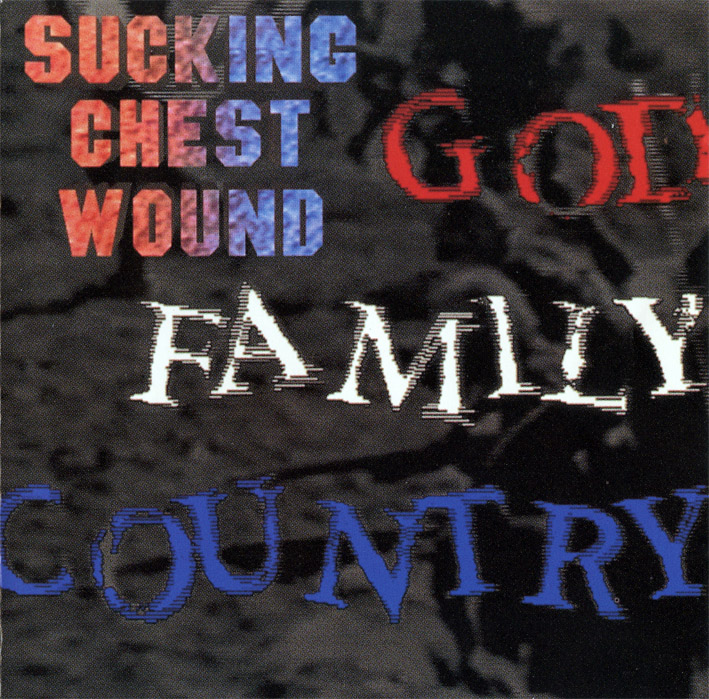
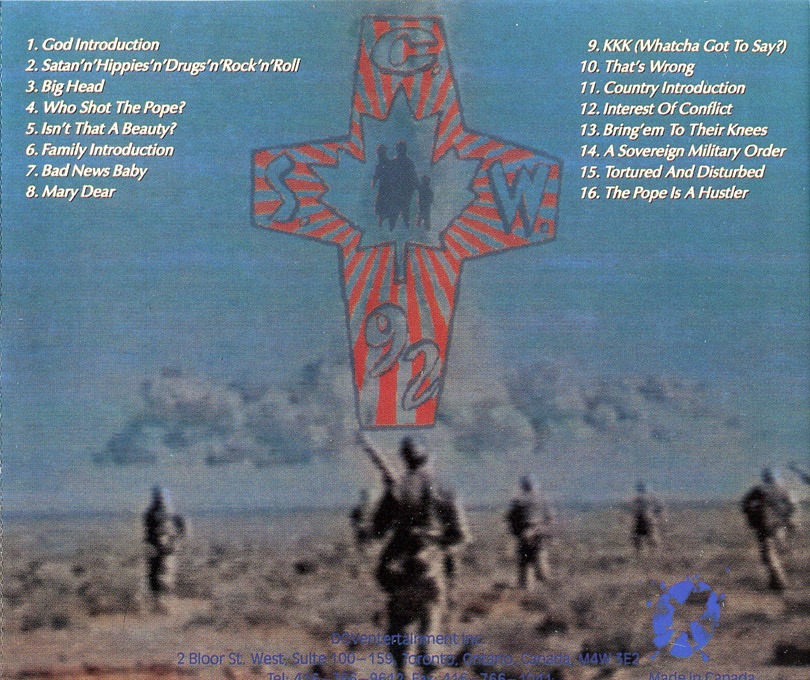
After first performing the God Family Country show in 1989, then releasing the 3-cassette package in 1990, it wasn’t until 1992 that GFC was released on that new-fangled recording medium, the compact disc. Up to that point SCW had released all their material themselves, but the GFC CD was released on a Toronto record label called Death of Vinyl (DoV). One extra tune was added for the CD – a reinterpretation of dWM’s Who Shot the Pope? entitled The Pope is a Hustler, recorded live in Montreal (more on that show later).
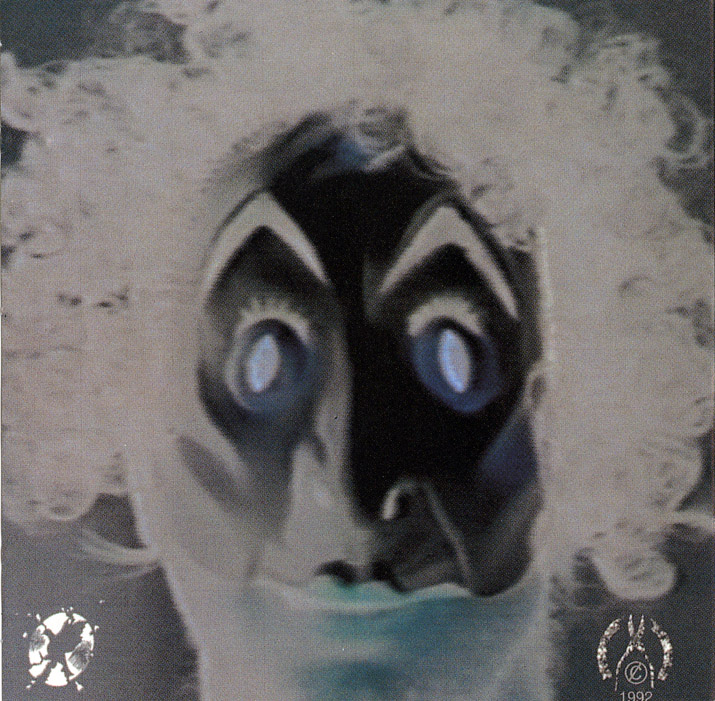
Here’s the CD artwork, based on image captures from the 1989 GFC show and with additional graphic design by band comrade (and very early SCW member) Philip G Brown.
Here’s a choice selection of tunes from the GFC CD
The Pope is a Hustler (Superstar Mix)
A live version of dWM’s ‘Who Shot the Pope?’ recorded at Montreal’s Foufounes Electriques in August 1991. Listen carefully and discover who shot the goddam Pope.
The Pope is a Hustler (Superstar Mix)
Big Head
One of Roba’s tunes, this was included in the ‘God’ section of the CD. Roba liked to use obscure jazz samples for his compositions.
Big Head
Isn’t That a Beauty?
What is that makes a absolutely great basketball player? Jeff-0 asks Olivier Messiaen & Norman Vincent Peale.
Isn’t That a Beauty?
KKK (Whatcha Got to Say?)
dWM scratches KKKool and the Gang only to discover what lies underneath.
KKK (Whatcha Got to Say?)
Mary Dear
Mary is being quite contrary. Jeff-0 mashes up Slayer with a CBC radio drama.
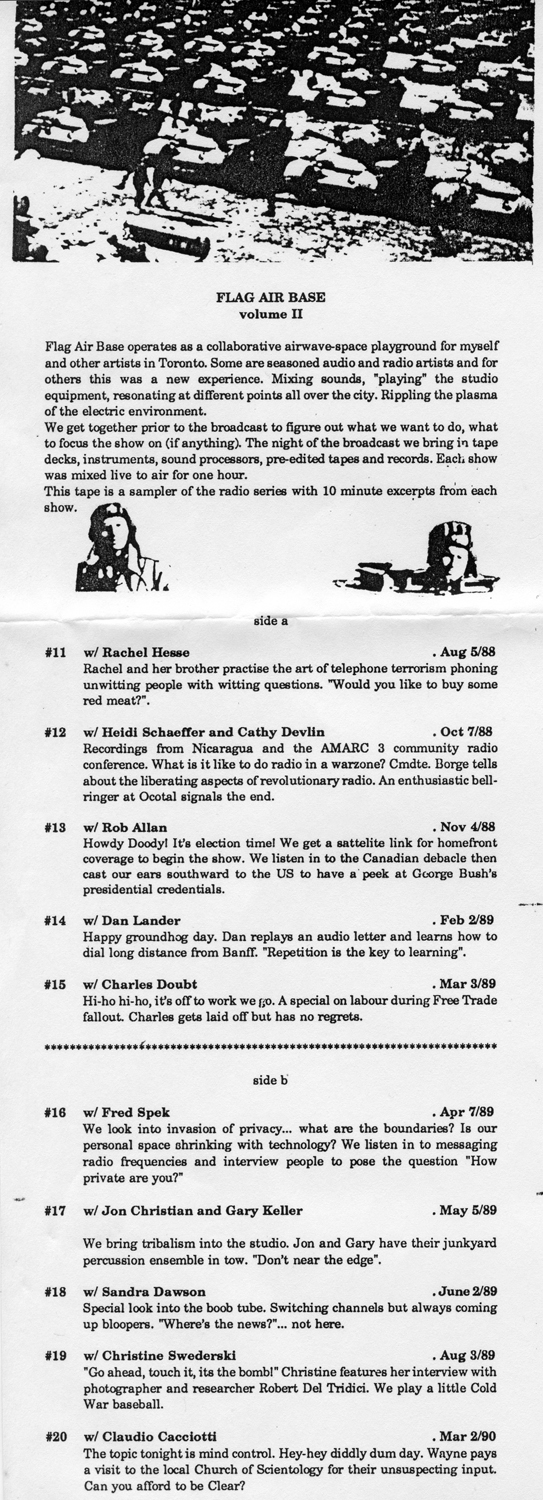
In 1987 dWM resumed his assault on the airwaves of Toronto with Flag Air Base, broadcast live on CKLN-FM. The premise of FAB was to invite different guests for each episode to create a set of improvised sonic mayhem. Depending on who was guesting, any given episode might be concerned with politics (Nicaragua, atomic weapons), found sounds, live instruments or pure noise. Here’s how dWM describes it:
Flag Air Base operates as a collaborative airwave-space playground for myself and other artists in Toronto. Some are seasoned audio and radio artists and for others this was a new experience. Mixing sounds, “playing” the studio equipment, resonating at different points all over the City.Rippling the plasma of the electric environment.
We get together prior to the broadcast to figure out what we want to do, what to focus the show on (if anything). The night of the broadcast we bring in tape decks, instruments, sound processors, pre-edited tapes and records. Each show was mixed live to air for one hour.
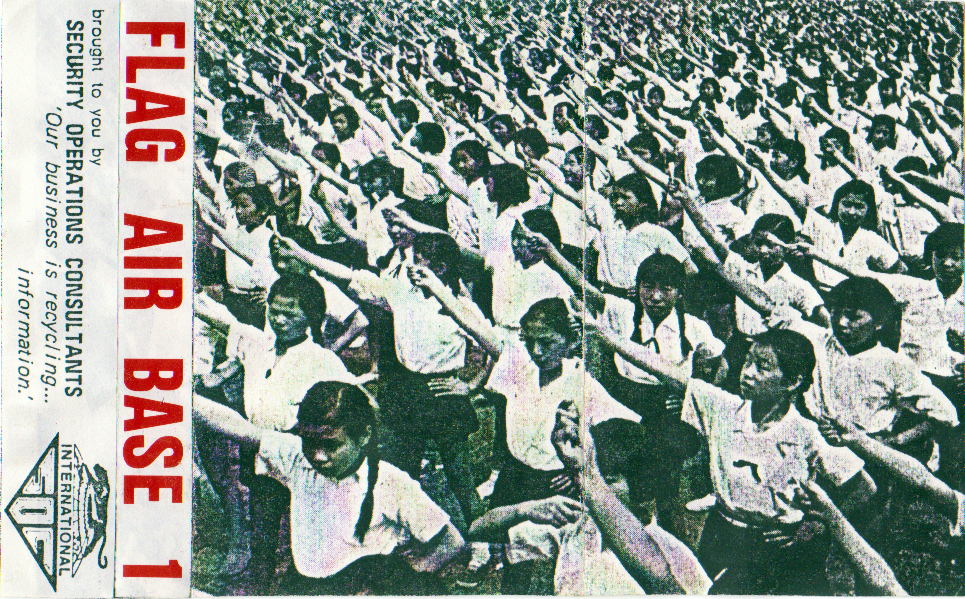
In total there were 20 shows produced between 1987-1990. Each show was released as a limited-edition cassette. Here’s the artwork for the FAB #1 cassette (designed by PnrH)
FAB #1 cassette tape cover
Here’s some choice excerpts from the various FAB shows:
FAB #1 w/ PnrH – Sept 4/87
Sound Earthquake in Toronto, 9 Richter scale. We jam the signals and mess the frequencies in this free-form display of sonic chaos
FAB #2 w/ Karen Young – Oct 2/87
A child is having slug problems with his lettuce. Karen brings in her big beat blaster to express her profound funkiness. Then we show our respect for facts.
FAB #7 w/Greg Hermanovic – Apr 8/88
Spine-tingling chills! “I thought you knew, civilization ended miles back”. Greg mixes his recordings from China and Southeast Asia until it gets too racy at the end. “Hello Baby, want a kiss?”
FAB # 12 w/Heidi Schaeffer & Cathy Devlin – Oct 7/88
Recordings from Nicaragua and the AMARC 3 community radio conference. What is it like to do radio in a warzone? Cmdte. Borge tells about the liberating aspects of revolutionary radio. An enthusiastic bell-ringer at Ocotal signals the end.
FAB #14 w/ Dan Lander – Feb 2/89
Happy groundhog day. Dan replays an audio letter and learns how to dial long distance from Banff. “Repetition is the key to learning”.
FAB #17 w/ Jon Christian & Gary Keller – May 5/89
We bring tribalism into the studio. Jon and Gary have their junkyard percussion ensemble in tow. “Don’t near the edge”.
FAB #20 w/ Claudio Cacciotti – Mar 2/90
The topic tonight is mind control. Hey-hey diddly dum day. Wayne pays a visit to the local Church of Scientology for their unsuspecting input. Can you afford to be clear?
Two ‘best of’ FAB cassette compilations were also issued. Here’s the artwork (by dWM)
In 1988 SCW put out their fourth and final cassette-only release, The Band with an International Reputation. Side A of the cassette was titled Crush Grind and Swallow, and contained tracks recorded and overdubbed on multi-track and then mixed down. Side B was titled Disco Dancing With the Best and was recorded direct to cassette, live off the floor at SCW’s Queen St. West studio/rehearsal/living space.
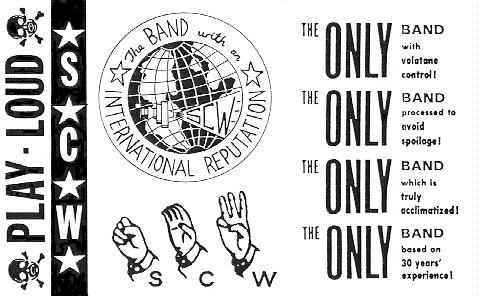
The Band with an International Reputation – cassette insert
The first track is classic SCW, mixing live instrumentation with samples, tape loops, effects etc.
A Pretty Uncomfortable Area
For this cassette release, each band member was invited to write and record their own tracks – here’s one of Roba’s prime cuts.
America Wake Up!
This last track is the live band with overdubs and was recorded and engineered by our friend GBH at his studio. It was also sampled and regurgitated on SCW’s next release, God Family Country.
In April 1986 PnrH and dWM wrapped up their weekly Building Balanced Children radio show on the Toronto community radio station CKLN-FM. dWM promptly started a new weekly radio show; the groundbreaking culture-jamming Why Pay More? The premise of Why Pay More? was to create a meta-radio show by sampling bits of all the previous weeks’ shows broadcast on CKLN, and then slicing, dicing, processing and regurgitating the content into a weekly 30 minutes of radiophonic mayhem. The show lasted until September of 1986. Check out the Best of Why Pay More? compilation:
In January 1986 PnrH and dWM began a weekly radio show on CKLN-FM, a Toronto community station. The show was called Building Balanced Children and the premise of the show was to perform a live improvised mixdown using 100% sampled material. They used turntables, tape loops, digital delays and the first affordable digital sampler – the Ensoniq Mirage.
They performed the Building Balanced Children show under the name Security Operations Consultants, which they would also use for a live performance in the fall of 1986.
The Building Balanced Children show lasted until April 1986, and during its run produced some of the most extreme music being broadcast on the Toronto air waves at the time. Hear for yourself – here’s both sides of the BBC compilation tape release:
Best of BBC Side A
Best of BBC Side B
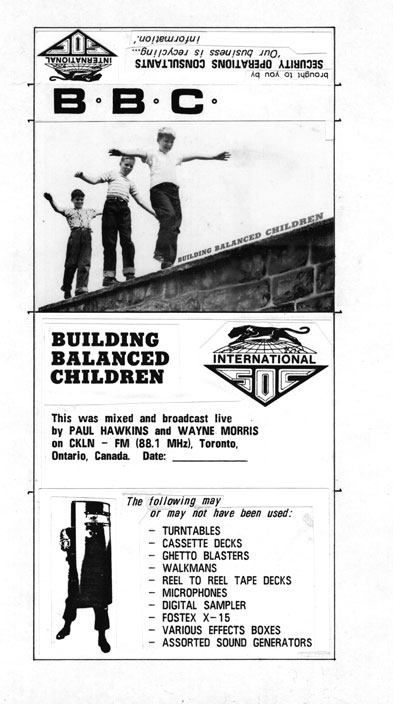
The original PnrH artwork for the Best of BBC cassette tape
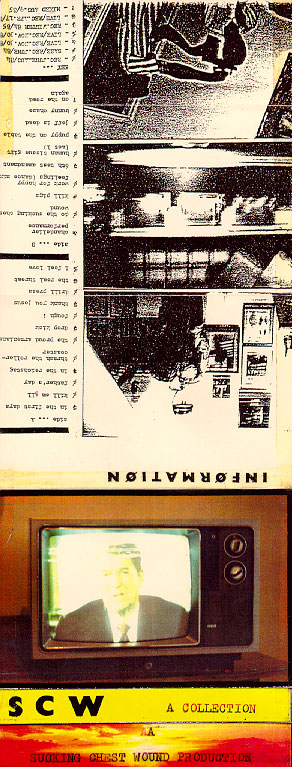
After the move to Toronto, in 1985 SCW released the compilation cassette tape “A Collection”. This consisted of greatest hits from the first two tapes and selected recordings from their live shows. We won’t post any audio here because it’s documented in previous posts.
“A Collection” cassette tape cover – folded out – by PnrH
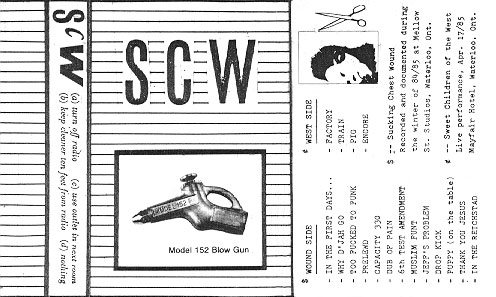
SCW’s second release on cassette came out in mid-1985 and was a mixture of new material and live recordings from the Sweet Children of the West show in April that year. The new material continued in the same techno-industrial post-punk style of the first cassette, with added horns in some tunes. This release marked the end of SCW’s use of analogue synths, and drum machines – all future work was done using either ‘real’ instruments played live or digital samplers, drum machines and effects.
“Model 152 Blow Gun” cassette tape cover – folded out – by PnrH
In the First Days…
Bass, tapes and drum machine…
6th Test Amendment
Same as above but with added synths
Drop Kick
SCW gets jazzy. Horns would become a bigger part of SCW’s sound in subsequent incarnations, first as a free jazz ensemble and then as a disco-jazz-funk- punk band.
Puppy (on the table)
Sit see the puppy on the table…
Thank You Jesus
Sequenced drum machine and synths plus tapes
In The Reichstag
Hitler invades Poland – ’nuff said…
SCW also produced a video to accompany one of the new tunes, Capacity 330. Most of the video footage was recorded at SCW’s Willow St. practice/living space
The second side of the Model 152 Blow Gun cassette is a live recording from April 17, 1985. See the previous post for some video footage of the show.
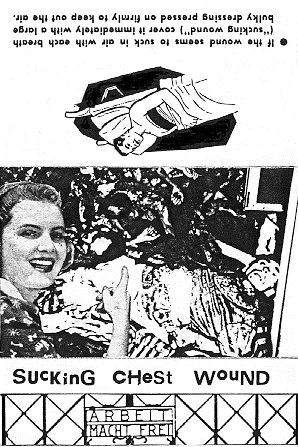
By mid-1984 SCW had established a living, rehearsal and recording space at Willow St. in Waterloo, Ontario, and had access to the electronic music labs at the University of Waterloo. In August of that year they released their first cassette, entitled Arbeit Macht Frei.
“Arbeit Macht Frei” tape cover – folded out – by PnrH
The cassette was 90 minutes long, with over 30 individual tunes. Here’s some highlights:
Kill Pigs
All you wanna do is kill yourself
All you wanna do is kill yourself
Why’re you trying to kill yourself?
Why aren’t you trying to…
Kill Pigs!
Kill Pigs!
Kill Pigs!
SCW salutes their punk roots…
Ashes In My Bier
Featuring vocals from our dearly departed friend Geoff Hendry. He hated people using his beer bottle as an ashtray at parties. Geoff was SCW’s sound man, recording engineer, roadie and #1 fan. He took his own life in 1994 and is still missed:
Father’s Day
This piece shows the influence of other bands that were using found audio at the time, such as Throbbing Gristle and Caberet Voltaire:
Interlude
This piece was done using the pause/rewind buttons on a consumer cassette recorder, several years before SCW got their hands on digital samplers:
Trash The Roller Coaster
SCW was strongly influenced by funk, disco and go-go music. In fact, in the late 80’s SCW became a live disco-jazz-funk-punk band. More on that later. In the summer of 1984 James Brown played a week-long residency in Kitchener, preparing the band for his North American tour. SCW came out several times to see the Godfather, and at one show our band was mistaken for Cano, who were apparently also in town. This tune is SCW’s dada-ist take on the Ohio Players’ Love Roller Coaster, featuring Mr. T on guitar, who would later join SCW for their final live show in 1997:
Work For Happy Feelings
More disco influence. This tune used the Roland TR-606 driving the SH-101’s sequencer:
…and a less disco/more rock instrumental version…
Do The Sucking Chest Wound
Like everybody else, SCW was heavily influenced by reggae and dub.This was the SCW theme song…
(fough)
I don’t wanna work… Dub and acid. 10 years after recording this tune, the dub influence took hold on SCW in a major way…
In 1984 the four members of SCW were all students at the University of Waterloo in Ontario, Canada. Jeff-0 and dWM had enrolled in David Huron‘s computer music course, thereby gaining access to the electronic music studio in the basement of Conrad Grebel College. The studio was equipped with recording facilities, a grand piano, a Roland Juno-60 synthesizer, an E-mu Drumulator, and a huge Moog modular synthesizer (either a model 55 or 3C). SCW had absolutely no idea what they were doing when they were using most of the gear, especially the Moog. However large portions of the first SCW tape release were created and recorded in this studio.
Here is a raw recording of experimentation using the Moog modular and Juno-60 (with the Moog sequencer triggering the Juno arpeggiator). Some of this material was used on the first SCW cassette tape release.

 Sucking Chest Wound